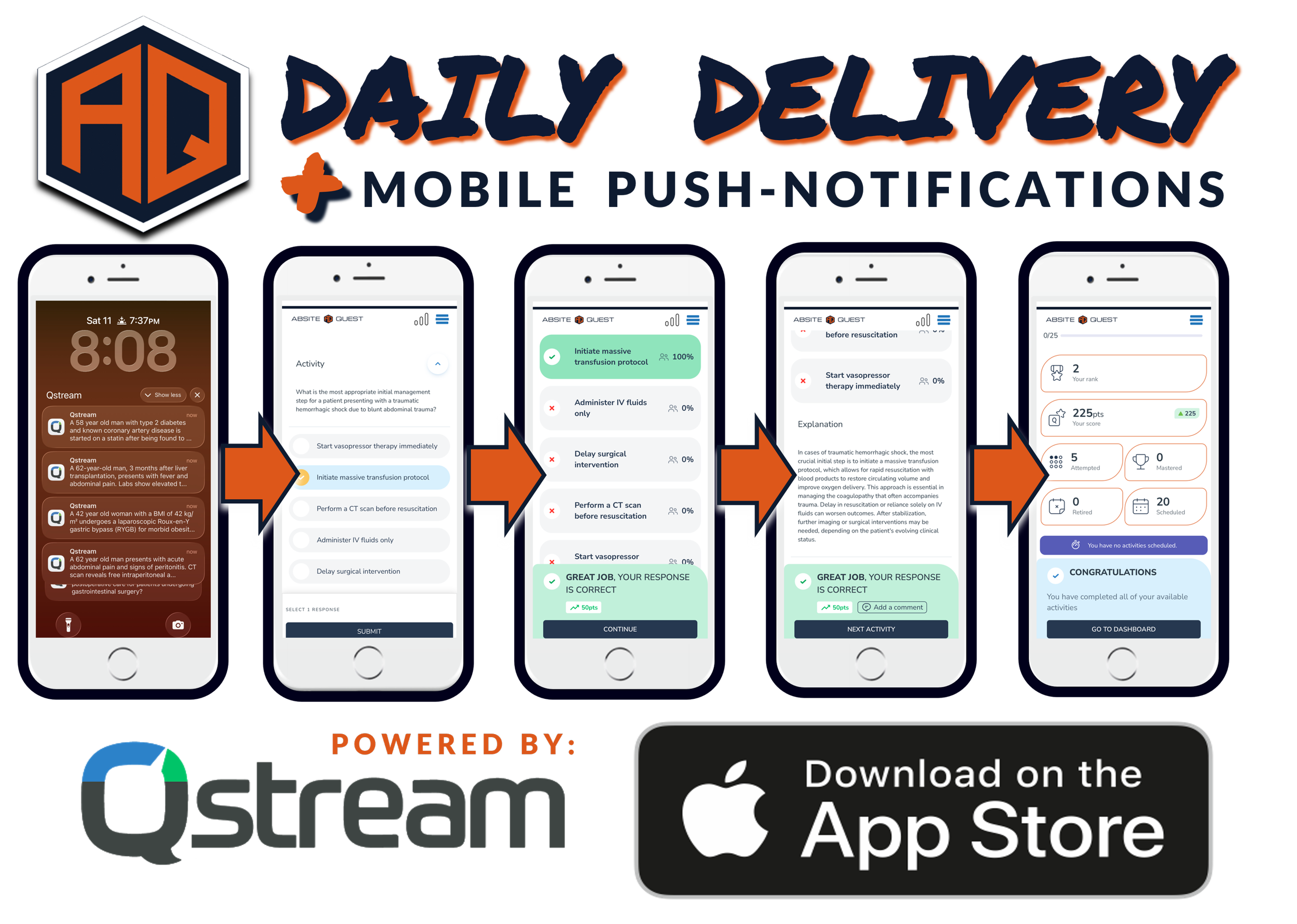
The average person checks their phone over 96 times a day. General surgery residents check their phones throughout the day, often between rounds, cases, consults and pages. Yet many traditional educational activities still require residents to sit through lengthy lectures, log into complicated platforms or find uninterrupted study time that rarely exists.
This mismatch between how residents actually use technology and how surgical education is often delivered creates a persistent—but solvable—problem.
Text-based learning, delivered through SMS or another mobile-first platform, is more than a convenient way to distribute educational content. Short, focused learning interactions can help residents reinforce important concepts, identify knowledge gaps and retain information over time without adding another major obligation to an already demanding schedule.
What Is Text-Based Learning?
Text-based learning is a structured educational experience delivered primarily through short written messages. These messages may include clinical questions, case scenarios, explanations, reminders or challenges sent directly to a resident’s phone.
Unlike lengthy online modules or scheduled classroom sessions, text-based learning is designed to fit naturally into the workflow of surgical training.
A resident might answer a question about postoperative hyponatremia while waiting for conference to begin. Another might review the management of blunt splenic injury between consults. A chief resident could receive a quick refresher on operative decision-making before starting a case.
Effective text-based learning typically includes:
Mobile-friendly delivery without complicated navigation
Notifications that prompt residents to engage
Short learning sessions that can be completed in a few minutes
Repeated exposure to important concepts over days or weeks
Questions that require active recall rather than passive reading
The goal is not to replace operative experience, conferences, textbooks or independent study. Instead, text-based learning reinforces those experiences by keeping important information active and accessible.
Why Mobile Delivery Works for Surgical Residents
Less Friction and Fewer Barriers
Residents already use multiple systems to review patient charts, answer messages, complete evaluations, log cases and access educational resources. Adding another platform with a separate login can make even valuable content feel like one more administrative task.
Mobile-first learning reduces that friction.
A question appears directly on the resident’s phone. There is no need to remember to visit a website, locate a bookmarked page or set aside a large block of time. The resident can engage with the material when a brief opportunity appears.
In a training environment where attention is constantly divided, making education easier to access can meaningfully improve participation.
Learning in the Small Gaps of the Day
General surgery residency rarely provides predictable, uninterrupted study periods. Learning often happens in small intervals:
Before morning report
Between operations
While waiting for imaging
During a quiet moment on call
On the commute home
Before going to sleep
Traditional study methods may not fit into these brief windows. A focused clinical question can.
When each interaction takes only a few minutes, residents can continue learning without needing to reorganize their entire day.
Active Recall Instead of Passive Review
Reading an explanation can create familiarity with a topic, but familiarity is not the same as being able to retrieve the correct information during an examination or clinical encounter.
Question-based text learning requires residents to make a decision before seeing the answer. That act of retrieval strengthens memory and helps reveal areas of uncertainty.
For example, a resident may feel comfortable with the management of acute pancreatitis until asked to determine when intervention is indicated for infected necrosis. Attempting the question exposes whether the resident can apply the concept rather than simply recognize it.
This makes each question both an educational activity and a brief assessment.
Repetition Without Cramming
Residents are expected to retain an enormous amount of information across trauma, critical care, oncology, gastrointestinal surgery, vascular surgery, endocrine surgery and other specialties.
Reviewing a topic once is rarely enough.
Text-based learning allows important concepts to return at spaced intervals. A question answered incorrectly can be repeated later, after the resident has had time to review the explanation. Material can also be revisited before it is forgotten.
This approach transforms studying from a single intensive session into a continuous process of retrieval and reinforcement.
Education That Reaches Residents Wherever They Are
Surgical residents rotate through operating rooms, clinics, intensive care units, emergency departments and multiple hospitals. Access to a desktop computer or reliable institutional Wi-Fi may vary considerably throughout the day.
Mobile learning travels with the resident.
Because the educational content is available through a phone, residents can participate regardless of their current rotation, clinical location or access to a workstation. This makes it especially useful for programs whose residents are distributed across several training sites.
Supporting ABSITE Preparation Throughout the Year
Many residents increase their studying in the weeks immediately before the ABSITE. While concentrated review can be useful, it is difficult to relearn an entire year of material in a short period.
Text-based learning supports a more sustainable approach.
A small number of questions completed consistently throughout the year can expose residents to hundreds of clinical scenarios. Residents receive regular feedback, programs can identify recurring areas of weakness and difficult concepts are revisited before examination season begins.
Instead of relying entirely on last-minute preparation, residents build and maintain their knowledge over time.
The Bigger Picture: Rethinking Surgical Education
Traditional surgical education was built around scheduled conferences, textbook chapters and learning through clinical experience. Each remains essential, but the realities of residency have changed.
Residents now move rapidly between clinical responsibilities, digital systems and competing demands for their attention. Educational methods must account for that environment.
Mobile technology allows learning to be brief, frequent and integrated into the normal rhythm of residency. It also makes it easier to apply educational strategies such as active recall, spaced repetition and targeted remediation at scale.
Text-based learning represents a different approach to resident education—one that treats learning as an ongoing process rather than an isolated lecture or a period of intensive studying before the ABSITE.
For busy general surgery residents, the most effective educational tool may not always be the one that demands more time. It may be the one that uses the small amounts of time they already have more effectively.