Balancing residency, studying, sleep, relationships, and life outside the hospital is difficult. Adding ABSITE preparation to an already demanding general surgery schedule can make it feel like there simply are not enough hours in the week.
The good news is that effective ABSITE preparation does not require spending every free evening buried in a textbook.
A structured study plan, consistent practice questions, and realistic weekly goals can help you prepare for the American Board of Surgery In-Training Examination (ABSITE) without allowing studying to take over your life.
The key is consistency.
ABSITE preparation can quickly fall behind when rotations become busy, which is why establishing a manageable routine early in the year can make January considerably less stressful.
Here is how to build an ABSITE study strategy that actually fits into general surgery residency.
What Is a Good ABSITE Score?
The ABSITE consists of 250 multiple-choice questions covering the knowledge expected of general surgery residents.
ABSITE score reports include two primary measures:
Percentage correct
Standard score
Historically, many residents and programs focused heavily on percentile rankings. However, the American Board of Surgery discontinued reporting ABSITE percentiles beginning in January 2025.
The ABS has emphasized that standard scores and percent-correct scores are more precise measures of resident knowledge than percentile rankings.
The ABS also provides a tool demonstrating the relationship between ABSITE standard scores and the probability of ultimately passing the General Surgery Qualifying Examination.
So what actually counts as a good ABSITE score?
There is not necessarily one number that defines success.
A strong performance generally demonstrates both an adequate knowledge base for your level of training and continued improvement throughout residency. Programs may also evaluate scores in the context of postgraduate year, previous performance, clinical progress, and overall educational development.
For junior residents especially, the ABSITE should be viewed as a tool for identifying strengths and weaknesses rather than simply as a final grade.
Look at your results and ask:
Which subjects are consistently strong?
Which topics need additional review?
Did your performance improve compared with last year?
Are there recurring knowledge gaps that should become priorities for the next several months?
The most useful ABSITE score is one that helps guide what you do next.
ABSITE Prep Strategies That Fit Into Residency Life
The biggest challenge with ABSITE preparation usually is not finding study resources.
It is finding time to use them.
Rather than relying on marathon study sessions that may never happen during a busy rotation, build your preparation around smaller and more sustainable habits.
1. Use Microlearning Throughout the Day
You do not need an uninterrupted two-hour study block to make meaningful progress.
Short, focused study sessions can be extremely effective, especially when they involve active recall.
Ten or 20 minutes may be enough time to:
Complete several practice questions
Review the explanations from questions you previously missed
Work through a handful of flashcards
Review one high-yield topic
Revisit an algorithm or management pathway you frequently forget
These small sessions are easier to fit around residency.
You might answer several questions while eating breakfast, review missed questions between cases, or complete a short session when you get home.
Twenty minutes may not seem significant, but repeated consistently over several months, those sessions add up.
2. Set Weekly Goals Instead of Perfect Daily Goals
Residency schedules are unpredictable.
You may have every intention of completing 20 questions after work only to spend the evening operating, managing consults, or finishing notes.
Rigid daily study schedules can therefore become frustrating very quickly.
Consider setting weekly goals instead.
For example:
Complete 100 ABSITE questions and review every incorrect answer by Sunday.
How those questions are distributed throughout the week does not matter nearly as much as completing them consistently.
You might answer 10 questions on a busy call day and 40 on your day off.
This approach allows your study schedule to adapt to residency rather than constantly competing with it.
When planning your studying, it can also be helpful to make sure your review covers the major categories included in the ABSITE content outline rather than repeatedly studying only your favorite subjects.
3. Make Practice Questions the Foundation of Your Studying
Passive studying can feel productive.
You can read a chapter for an hour and finish feeling as though you covered a lot of material.
The problem is that recognizing information while reading is very different from retrieving that information when presented with a clinical scenario.
Practice questions force you to actively retrieve knowledge, distinguish between similar answer choices, and apply surgical principles to clinical situations.
For each question you answer, focus on more than whether you selected the correct choice.
Ask yourself:
Why is the correct answer correct?
Why are the other options incorrect?
What detail in the question should have pointed me toward the answer?
Would I recognize the same concept if it were presented differently?
The explanation following the question is often where much of the learning occurs.
4. Study Your Weakest Subjects More Than Your Favorite Ones
Most residents have topics they naturally enjoy.
It is tempting to spend extra time reviewing subjects you already understand because studying them feels productive.
Your ABSITE performance, however, will often improve more by targeting the areas where you consistently miss questions.
Use your question bank analytics and previous ABSITE results to identify those weaknesses.
For example, if your performance is consistently lower in:
Pediatric surgery
Transplantation
Vascular surgery
Trauma
Surgical critical care
Endocrine surgery
those subjects should receive disproportionately more study time.
A good study plan should become increasingly personalized as the year progresses.
5. Take Timed Practice Exams
Knowing the material is only part of performing well on the ABSITE.
You also need enough stamina and pacing to work through a long examination without rushing through the final portion.
The ABSITE is administered in two testing blocks of approximately 2.5 hours each.
Timed mock examinations can help you practice:
Maintaining concentration
Managing your pace
Deciding when to move on from a difficult question
Avoiding unnecessary second-guessing
Performing under realistic testing conditions
Try to complete at least one realistic practice examination before the ABSITE.
Afterward, spend as much time reviewing the questions as you spent taking the examination itself.
Understanding why you missed a question is considerably more valuable than simply knowing your score.
Why ABSITE Question Banks Are So Effective
Question banks are one of the most useful tools available for ABSITE preparation because they combine several important learning strategies at the same time.
Research involving surgical residents has demonstrated an association between completing more practice questions and improved ABSITE performance.
That makes sense.
A high-quality ABSITE question bank allows you to repeatedly practice retrieving information while simultaneously identifying weaknesses and becoming familiar with the style of questions you may encounter on the examination.
An effective question bank can help you:
Identify knowledge gaps
Reinforce high-yield concepts
Practice clinical decision-making
Improve long-term retention
Track your progress throughout the year
Become more comfortable with ABSITE-style questions
Focus additional studying on your weakest subjects
The goal should not simply be to complete as many questions as possible.
The goal is to learn something from every question.
How ABSITE Quest Can Fit Into Your Study Routine
ABSITE Quest was designed specifically around the reality of general surgery residency.
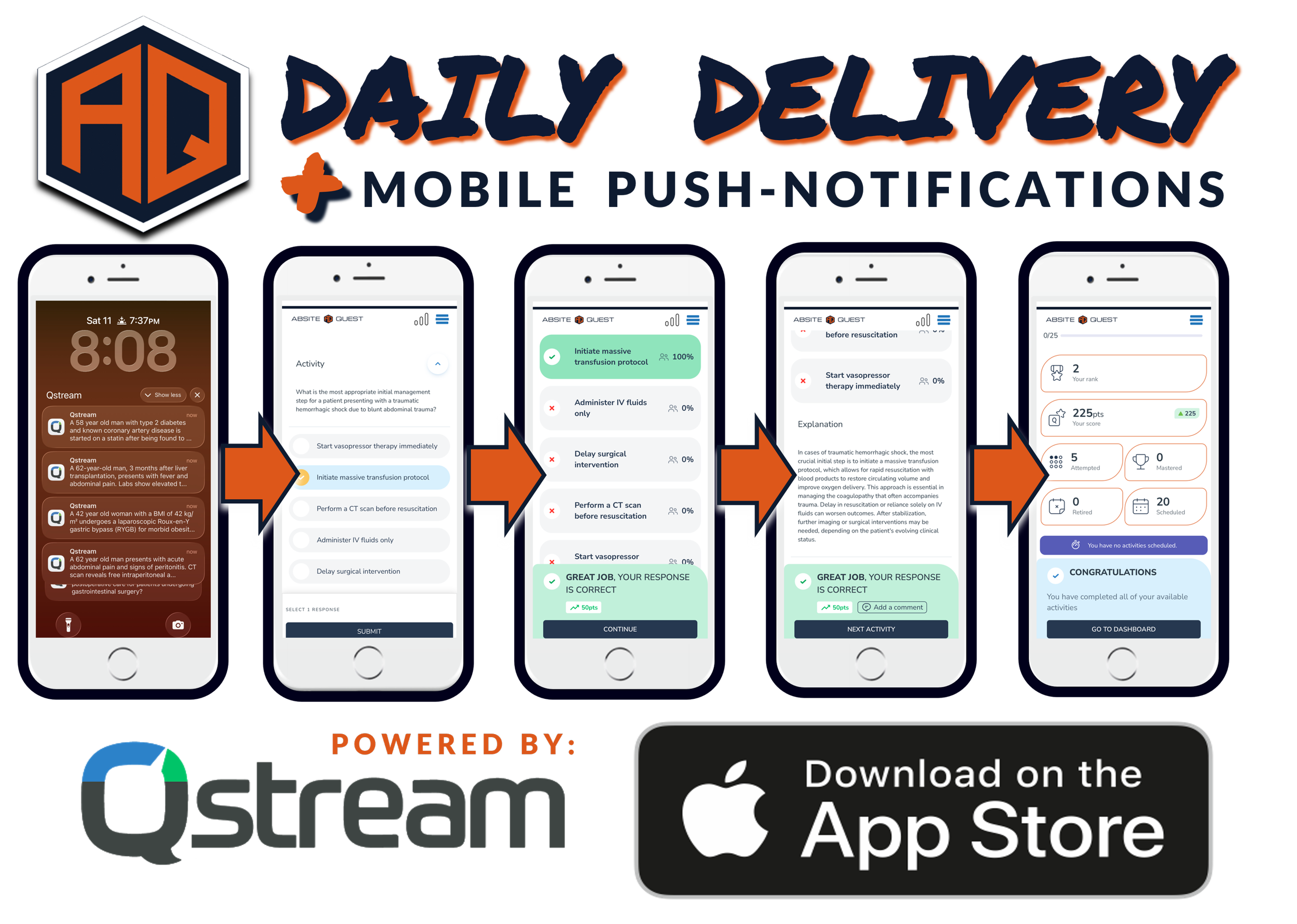
Rather than requiring residents to carve out large blocks of dedicated study time, ABSITE Quest helps make board preparation part of your normal routine.
Residents can work through ABSITE-style questions throughout the year, review detailed explanations, identify areas of weakness, and monitor their progress as the examination approaches.
The platform also incorporates spaced learning to repeatedly reinforce important concepts over time.
Instead of encountering a topic once and hoping you remember it months later, important concepts can be revisited throughout your preparation.
This approach makes it easier to turn short periods of downtime into meaningful studying.
A few questions before rounds.
A short review between cases.
Another session after dinner.
Individually, those sessions seem small. Over the course of six months, they can represent hundreds or thousands of opportunities to strengthen your surgical knowledge.
Create an ABSITE Study Schedule You Can Actually Maintain
An effective study schedule does not need to be complicated.
For many residents, a reasonable approach might look something like this:
August–October:
Begin answering questions consistently and identify major weaknesses.
November–December:
Increase question volume and spend more time reviewing weaker subjects.
Early January:
Begin more comprehensive review and complete a timed mock examination.
Final weeks before the ABSITE:
Review missed questions, high-yield concepts, and persistent weaknesses rather than trying to relearn the entire field of surgery.
The exact timeline matters less than starting early enough that you do not need to rely on cramming.
Even a modest weekly question goal becomes powerful when maintained for several months.
Do Not Ignore Sleep and Recovery
Studying matters.
So does sleeping.
Residency already places substantial demands on your physical and mental energy. Trying to compensate for inadequate preparation by sacrificing sleep during the final weeks before the ABSITE is rarely an effective strategy.
Sleep deprivation can impair concentration, memory, decision-making, and overall performance — exactly the abilities you need when answering hundreds of clinical questions.
If you have just finished a long call or an exhausting operative day, another two hours of low-quality studying may provide less benefit than getting adequate rest and returning to your questions the following day.
Your study plan should therefore include recovery rather than treating it as lost study time.
Consistency over several months is far more sustainable than trying to compensate with an intense final push.
The Best ABSITE Study Plan Is the One You Can Sustain
There is no perfect ABSITE study schedule for every general surgery resident.
A PGY-1 on vascular surgery will have a very different week than a chief resident on an elective rotation.
Your study strategy needs to accommodate that reality.
Focus on a few fundamental principles:
Start early.
Answer questions consistently.
Review explanations carefully.
Track your weaknesses.
Set weekly rather than rigid daily goals.
Practice under timed conditions before the examination.
Protect enough sleep and recovery to actually retain what you are learning.
You do not need to study every free minute to perform well on the ABSITE.
You need a system that allows you to keep learning even when residency gets busy.
Twenty minutes today may not feel like much.
Twenty minutes repeated consistently for the next six months can make an enormous difference.